
The cell-autonomy (CAUT) lines of Arabidopsis
Download all of the pages below as an Adobe PDF file.
After selecting your lines based on the critertia below, please order them here
Cell-autonomy is a property of particular genotypes and is useful to examine developmental and/or signalling interactions between cells and tissues. Cell-autonomy is studied by producing genetic mosaics and chimeras containing tissue of differing genotypes and analysing the resulting phenotypes. A trait is completely cell-autonomous if the genotype and phenotype of the tissue always correspond irrespective of the genotype of the adjacent tissue. Conversely a trait is non cell-autonomous if the phenotype of either tissue is affected by the genotype of the adjacent tissue.
Cell-autonomy has been studied in plants using a variety of methods to generate the chimeric or mosaic plants. Such methods include; grafting, site-specific recombination, transposon excision and radiation induced deletion. The latter method has been used for many elegant studies in maize but in only one study of Arabidopsis (Furner et al 1996. Development 122; 1041-1050). In these studies recessive cell-autonomous colour markers are included in the experimental design to allow the routine identification of the tissue containing the appropriate deletion. This is comparatively easy in maize as many markers at different locations are available. In Arabidopsis there is a shortage of colour markers and finding a good cell-autonomous colour marker near a gene of interest is not usually possible.
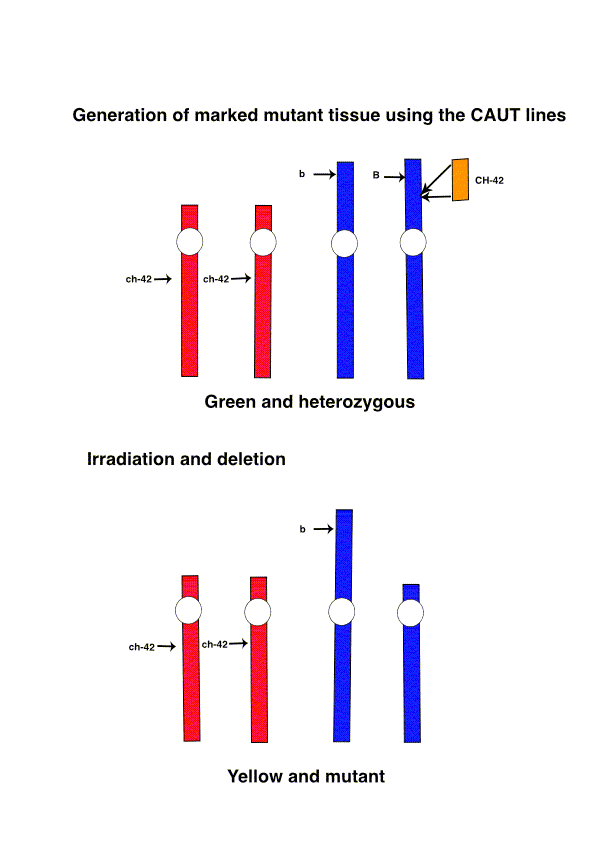 The CAUT lines are an attempt to overcome the shortage of useful
markers by artificially generating markers using genetic complementation
and Agrobacterium – mediated transgenesis. The idea is simple;
the recessive yellow ch-42 mutant can be complemented by
transformation with the dominant wild-type CH-42 gene on a T-DNA.
This has the net effect of translocating the CH-42 gene and the ability
to synthesise chlorophyll to a novel and unique location in each transgenic plant.
A recessive mutant trait of interest can be crossed into the yellow ch-42
mutant background. Subsequent crosses to an appropriate green T-DNA transformant
can generate a situation with the recessive mutant trait on one chromosome and
on the homologous chromosome the wild-type gene and the dominant green
CH-42 marker.
The CAUT lines are an attempt to overcome the shortage of useful
markers by artificially generating markers using genetic complementation
and Agrobacterium – mediated transgenesis. The idea is simple;
the recessive yellow ch-42 mutant can be complemented by
transformation with the dominant wild-type CH-42 gene on a T-DNA.
This has the net effect of translocating the CH-42 gene and the ability
to synthesise chlorophyll to a novel and unique location in each transgenic plant.
A recessive mutant trait of interest can be crossed into the yellow ch-42
mutant background. Subsequent crosses to an appropriate green T-DNA transformant
can generate a situation with the recessive mutant trait on one chromosome and
on the homologous chromosome the wild-type gene and the dominant green
CH-42 marker.
Click here or on the image for a larger view and further information
Setting up the experiment - step by step instructions
Help and advice
The CAUT lines were developed by Ian Furner and co-workers, if
you run into any problems or need advice on their use please feel free to
contact him at;
ijf@mole.bio.cam.ac.uk
or by surface mail at : The Department of Genetics University of
Cambridge, Cambridge, CB2 3EH UK.
